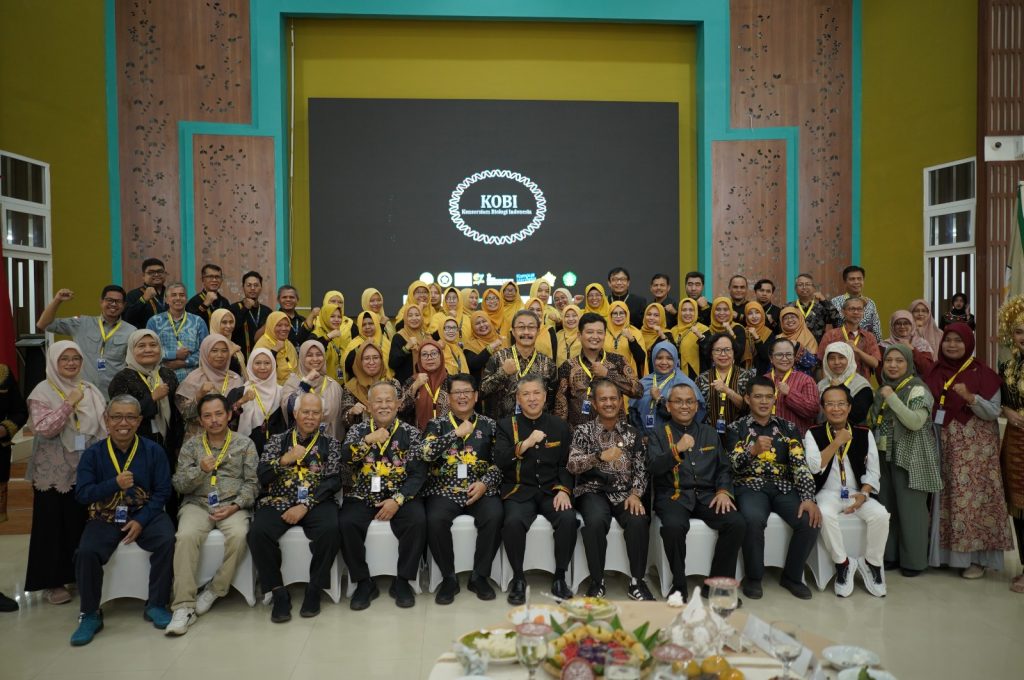
Banda Aceh — The 2024 National Working Meeting (Rakernas) of the Indonesian Biology Consortium (KOBI), held in Banda Aceh on 5 November 2024, served as a prestigious forum for academics, researchers, and biology practitioners across Indonesia. The event was organized by the Department of Biology, FMIPA Universitas Syiah Kuala (USK), in collaboration with the Biology Education Study Program of FKIP USK and the Biology Study Program of the Faculty of Science and Technology at UIN Ar-Raniry, with strong support from the Banda Aceh City Government, Bank Aceh Syariah, BPMA, and other partners.
In his opening remarks, the Dean of FMIPA USK, Prof. Dr. Taufik Fuadi Abidin, S.Si., M.Tech., expressed deep appreciation to all participants: “We are honored and proud to host this year’s KOBI Rakernas. We hope this meeting will strengthen inter-institutional synergy in formulating strategies to address increasingly complex environmental challenges. Through this forum, we expect the academic community to contribute more meaningfully to environmental conservation and the improvement of public well-being.”
The 2024 Rakernas convened biology experts from various institutions—academia, research centers, and industry with the objective of formulating strategic directions and work programs for the advancement of biological sciences in Indonesia. The discussions included research development, human resource capacity building, and the role of biology in addressing environmental and public-health challenges.
The Acting Mayor of Banda Aceh, Ade Surya, S.T., M.E., underscored the local government’s commitment by inviting all KOBI members to a gala dinner at the Banda Aceh Mayor’s Official Residence. The invitation aimed to strengthen partnerships between government and academia and to explore potential collaborative initiatives in environmental stewardship.
“We are ready to support initiatives generated from this meeting, especially those related to environmental conservation, public health improvement, and community empowerment. We hope the Rakernas produces innovative and impactful programs that we can continue to support,” he stated.
ICEBES 2024: International Collaboration on Biodiversity and Climate Change
As part of the Rakernas series, the 1st International Conference on Biology and Environmental Sciences (ICEBES) 2024 was held on 6 November 2024. ICEBES brought together global researchers to exchange ideas on biodiversity, climate change, sustainable development, and the role of biology in achieving these goals.
ICEBES Chair, Ir. Essy Harnelly, S.Si., M.Si., Ph.D., noted: “This conference is a major milestone for the Department of Biology FMIPA USK in initiating global collaboration and promoting environmental sustainability. Through ICEBES, we expect new and innovative ideas to emerge and international research partnerships to be further strengthened.”
ICEBES hosted renowned keynote speakers, including Assoc. Prof. Dr. Muh Izzuddin Syakir Ishak (Universiti Sains Malaysia), Prof. Dr. Iskandar Z. Siregar (IPB University), and Prof. Dr. Suhartono (Department of Biology FMIPA USK). Invited speakers included Chihjen Ko (GBIF Asia), Marius R. M. Ekue, Ph.D. (Alliance of Bioversity International & CIAT), and Dr. Lindsay F. Banin (UK Centre for Ecology & Hydrology). Fifty selected presenters from multiple countries shared their research, marking ICEBES as a significant knowledge-exchange platform at the international level. Conducted in hybrid format, the conference broadened access for a wider audience.
Concluding with Community Engagement: Mangrove Planting in Lampulo
The Rakernas concluded with a mangrove planting activity on 7 November 2024 at the Lampulo coast in Banda Aceh. The initiative involved students and faculty members from the Biology Department FMIPA USK, the Biology Education Program FKIP USK, and the Biology Study Program of UIN Ar-Raniry. This activity served both as environmental action and as public education on the importance of coastal ecosystem conservation.
Head of the Department of Biology FMIPA USK, Prof. Dr. Lenni Fitri, S.Si., M.P., emphasized: “This is not merely a ceremonial mangrove planting, but a form of direct environmental education. Young people, in particular, must understand that our environment will not remain safe if it continues to be neglected.”